Won 2nd🥈 place in Code4Cause Hackathon
Struggling to read can have long-term consequences. According to Yale Center of Dyslexia & Creativity, dyslexia affects 20% of the population and accounts for the majority of learning disabilities. An estimated 62% of students with reading difficulties drop out of high school.
We wanted to create a tool that makes reading easier, clearer, and more empowering for those with dyslexia — all with a click.
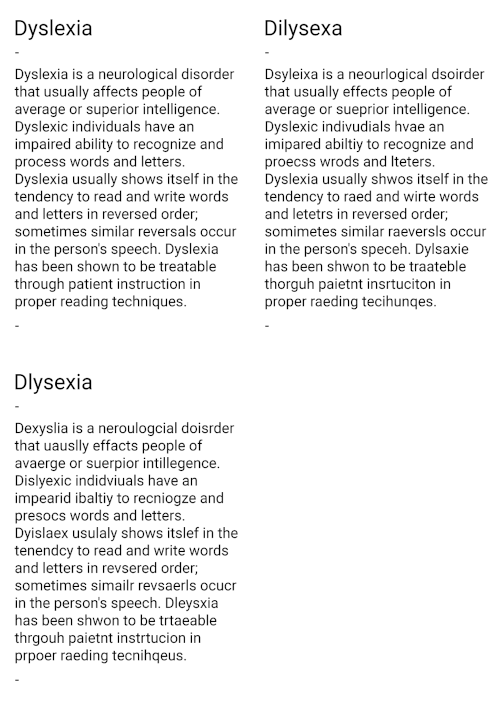
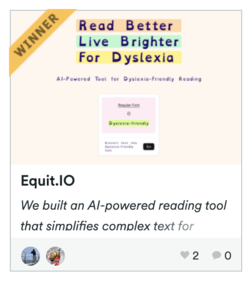
Equit.IO is an web app that converts regular text into a dyslexia-friendly format. It transforms fonts, adjusts spacing, and improves readability to reduce cognitive load for users with dyslexia.
- Dyslexia-Friendly Design : Follows the British Dyslexia Association's style guide for better readability.
- Enhanced Readability: Convert text in a PDF to a well-supported Dyslexia accessible and legible font.
- Reading Level Adjustment: Seamlessly change the reading level of the processed text.
- Concise Summarization: Quickly read a summary of the processed document.
- Text-To-Speech Capabilities: Easily listen to an audio recording of the processed text or summary, no downloads required.
- We plan to implement functionality in which users can create an account with EquitIO. This would allow for memory retention of the model, which would be huge for the project. Users would be able to revisit past documents, allowing them to repeatedly and efficiently interpret class assignments and articles.
- People with dyslexia often use color-guided strips for reading support. We also plan to implement a highlighting feature, which will make text even more legible and accessible for users with dyslexia.
- Frontend: Built with Next.js, Tailwind CSS, and shadcn/ui for a responsive and accessible user interface.
- Backend: PDF parsing & refining. AI functionality powered by OpenAI API model GPT 3.5-Turbo
- Design: Clean & Simple UI for users with dyslexia.
- Fine-tuning the GPT 3.5-Turbo model was difficult at first. Although quite cost effective, when untrained the model proves to be extremely generic and sometimes difficult to understand
- Implementing the core functionality of our software, file-uploading and text extraction. Storing the data of processed documents, and passing raw text to the OpenAI API.
In a mere team of two, we are extremely proud of our finished product. But to be more specific, we love how:
- Users are able to adjust the reading level of the output-text with just the click of a radio button! We were extremely proud of ourselves when this feature worked for the first time. In 2025, we have all been desensitized by the power of AI (primarily through ChatGPT), so it was awesome to see a model we trained output actual results.
- Integrating Text To Speech features, with an extremely realistic and tone-varying voice. This not only boosts the effectiveness of the app, but also it's practicality. No one wants to listen to something they don't understand!
Besides sharpening our skills in frontend development, the two of us learned:
- The significance of a properly tuned AI model for real-world applications.
- How to prompt, and more importantly, store files as input from the user
- How to parse through said files, grabbing the main content along with meta data
- How to dynamically-adjust an AI model's responses. Speaking in terms of front-end, through the state of buttons/forms. In terms of back-end, through the variables assigned to said buttons/forms.
- Equit.IO could be transformed into a browser extension, making the tool increasingly more accessible- acting as a plugin in which students could instantly refine and summarize any text (assignments, articles, etc).
- Although our immediate audience includes any student K-12 and beyond, Equit.IO could be offered as a subscription model for parents, tutors, and accessibility-focused organizations, increasing our market potential tremendously.